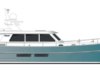
AMSTERDAM – It must be the most daring undertaking in sustainable yachting: The ne plus ultra of Dutch yacht building manufactures a 59m ketch that will sail 100% fossil-free.

Extraordinarily, it is an open-source event. The project’s build and design knowledge and data are not kept secret – as is the sector’s wont. Everything is shared with the world far beyond the Vitters Shipyard that is building the yacht amid the ruler-flat, emerald fields of northern Holland.
 It is an “impact investors” project allied in Foundation Zero, launched in a 2022 symposium of HISWA, the Dutch boating and water sports lobby. In the current issue of HISWA Magazine, Michael Steenhoff, the group’s head of yacht building, revisits the project on the eve of the 2023 In-Water-HISWA, an event at which fossil-free boating is a significant theme.
Steenhoff writes the fossil-free sailing yacht is the work of Yacht designers Dijkstra Naval Architects and Vripack Yachting. Vitters Shipyard is building it. “The unique aspect of this project is that the knowledge generated is available to everyone as ‘open source.”
The yacht must be able to sail without using fossil fuels, will be 69m (226ft) long and have two masts. Vripack handles the exterior and interior design, and Dykstra handles the hull design and stability.
“Four main research areas are energy generation, storage, conservation and management. It is assumed the sails mainly provide the “hotel operation,” i.e., all energy generated on board, minus the propulsion.”
When generating energy, the builders and designers think of reversible thrusters, propeller blade design, heat storage and power from the sun and other sources, such as the underwater hull and its appendages.
“A fresh breeze can generate about 1.5MW of energy, just about matching the output of a 70m wind turbine. To increase propeller efficiency, hydro generators are used.
“The designers are still investigating how to optimize the propeller’s efficiency in generation and propulsion modes. For this yacht, they chose two rotating pods that can be used for both energy propulsion and regeneration.
“They also looked at the drag of the underwater appendages and found the optimal balance between resistance and generating power.”
The yacht depends on stored solar energy for hotel operation. “This uses photovoltaic and thermal energy. Solar heat is extracted between 80 and 85C by using thermally well-insulated solar panels. Energy is saved through proper insulation of the hull and deck. “Thirty millimeters of cork is laid over the metal. Also, the hull is painted with infrared reflective paint that reduces heat absorption by about 20 to 25%.
Lithium batteries with sufficient power for autonomous yacht operations are needed to store the energy. “Because of the weight of the batteries, the yacht’s positioning is essential to contribute to stability. Furthermore, how to store energy in heat and cold loops and buffers is being investigated.
Rainwater collection, “recovery of residual heat from wastewater, natural ventilation and wall and ceiling cooling are other topics that will be addressed in the project. Data are of great importance for managing both the generation and consumption of energy. Data will be used to optimize the user interface and route planning based on weather and energy supply.”
https://www.foundationzero.org