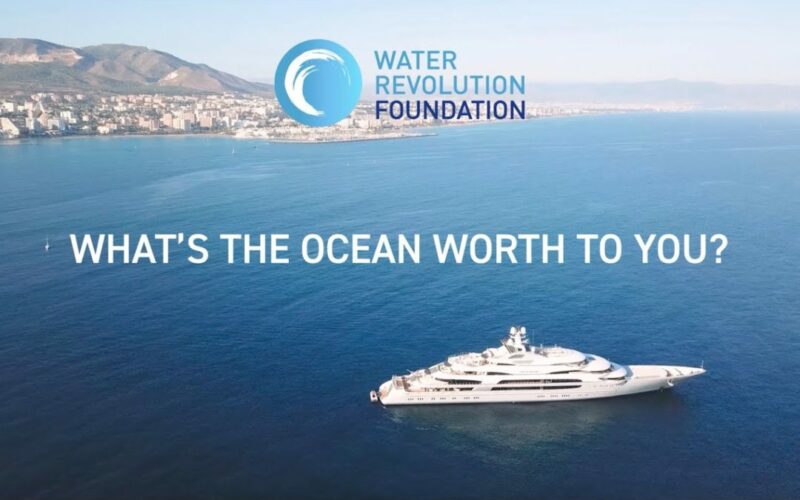
AMSTERDAM – It’s perhaps the world’s only non-profit organization preaching a revolution. A modest outfit, its superyacht sustainability drives a growing number of boat yards, yacht suppliers, and design and engineering studios far from its offices in a restored building in Amsterdam that was the 18th-century home of the city’s water management board.

Now in its 4th year, the Water Revolution Foundation comprises 40 superyacht sector companies and a dozen individuals worldwide. It has come into its own, as will become evident at the upcoming Metstrade show. Check them out!
WRF partners acknowledge their sector must make sound construction, design and propulsion choices in manufacturing or refitting large motor and sailing yachts to reduce their impact over their lifetime.
“If we can design, build and refit superyachts in a far more sustainable manner, we are not only tackling the problem at its source, we can embrace and accelerate the time-to-market of new sustainable solutions,” says WRF Executive Director Robert van Tol.
He was a busy man at the 2022 Monaco Yacht Show. In pursuit of the WRF’s sustainability campaign, he announced that:
- Hull Vane BV’s (Netherlands) energy-saving transom foil reduces a ship’s motion and stern wave, and merits a WRF Life Cycle Assessment rating. “The Hull Vane confirms its capacity to reduce fuel consumption and related emissions while having a negligible impact on the environment through its construction and end-of-life,” he said.
- The Explore E8 and E9 (Oceanled, UK) underwater lights have also been rated sustainable through the LCA assessment. “By providing maximum lighting effect with minimized power usage throughout its life cycle, Explore E8 & E9 exceed conventional onboard lighting systems in terms of effectiveness and sustainability,” said Van Tol.
- Hempaguard X7 anti-fouling (Hempel, Denmark) is also rated as a sustainable solution under the LCA methodology. It is an antifouling that uses advanced technology to extend the fouling-free period, according to the WRF, suitable for all yachts over 30m, with no limitations on service speeds.
Also at the Monaco Yacht Show, MTU, the Rolls-Royce Power Systems unit that makes yacht engines, became the WRF’s 14th Anchor Partner. It will contribute significant financial support and technological expertise and work with the foundation on applying LCA to superyacht engines.
Reducing superyachts’ environmental impact means implementing more sustainable solutions. To know if these are real solutions, not just marketing, these can be verified through LCA in the WRF’s online Database of Sustainable Solutions.
The WRF has a growing line-up of activities. Among these are its Yacht Assessment Tool (YAT) and the Yacht Environmental Transparency Index (YETI).
The former rates the environmental credentials of individual yachts so they can be compared with one another. It can assess a complete yacht or part of it and pinpoint the source of environmental impact. The YETI is a tool to compare superyachts by their environmental credentials. Like those colored stickers on household appliances.
“To make the fleet of superyachts more environmentally friendly and reward better choices, we need a reliable tool to assess and compare them,” says Van Tol.
The YETI tool enables the industry to tackle its environmental impact as it considers the unique character of yachts instead of applying a generic approach to all vessels. Its highly anticipated 1.0 version will be launched during METSTRADE.
www.waterrevolutionfoundation.org