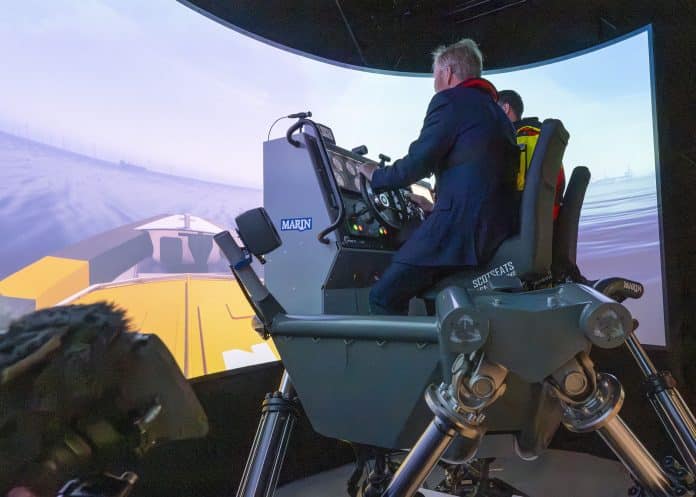
In late May, His Majesty King Willem-Alexander of the Netherlands inaugurated the Seven Oceans Simulator center (SOSc) at the Maritime Research Institute of the Netherlands (MARIN). It was a landmark event that marked a significant stride forward in MARIN’s 85-year journey toward revolutionizing ocean shipping, making it cleaner, smarter, safer, and more sustainable.

The SOSc, a €17m marvel, is a testament to MARIN’s commitment to maritime research and safety. It stands out for its cutting-edge technology and the ability to offer the most advanced and realistic simulations.
With the industry facing challenges such as larger container ships, increased sea traffic, and unpredictable weather conditions, the center’s advanced simulations and analytical capabilities are poised to be a game-changer.
Effectively simulating and analyzing complex sea situations promises to make shipping safer and more intelligent, thereby revolutionizing the industry’s approach to safety and efficiency.
The high-tech SOSc resembles a structure from Star Trek, the American science fiction media franchise based on the eponymous 1960s TV series. It is an impressive expression of the passion with which MARIN faces innovations and confirms its claim as the world’s largest independent maritime research outfit.
“The center’s most important task is to fulfill our mission to make shipping more safe, clean and smart and to contribute to sustainable use of the seas,” says MARIN managing director Bas Buchner. “The most important thing is to fulfill our mission to make shipping safer, clean, and smart and to contribute to sustainable use of the seas. Business comes next, but we definitely believe the SOSc will attract a lot of work.”
The opening of the Seven Oceans Simulator center has attracted the attention of superyacht builders and designers. Enrico Della Valentina, the head of MARIN’s yacht section, anticipates significant benefits for the superyacht industry, including enhanced crew training, safety at sea, and internal visualizations.
The SOSc can simulate all sorts of situations at sea, such as “entering and leaving berths, harbors, anchorages, etc. Training in abandon-ship operations, medical training for rescue operations, and onboard fire drills.”
He adds, “The center can help decide which steering devices are best for a yacht or area of operations. Or what does the view from the bridge look like? How can it be improved? This affects many people! Pilots, crews, sea rescue operators, governments, port authorities, design studios and so on.”
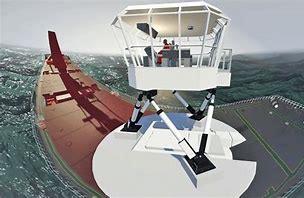
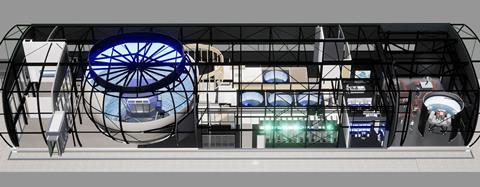
The SOSc has spherical and moving simulators, a virtual/augmented reality experiment room and human factor ‘measurement and observation techniques’.
Arno Bons, MARIN’s simulation & visualization manager, says: “The spherical simulators with moving bridges are unique in the world as environmental projection is not only all around, but also upward and downward. In the Maritime eXperience Lab, we research the latest VR/AR systems and apply them to maritime systems and operations above and below water. We can also link all simulators to each other to simulate complex multi-ship and multi-tool operations.”
“In addition to research into shipping safety,” adds Buchner, “the SOSc virtual test facility makes it possible to experience the behavior of future ships during the design phase, in which the role of the crew and onboard cooperation are central.
“It allows the national and international maritime sector to develop innovative ships with safe and maximum operational deployment under the most difficult sea conditions.”
MARIN’s SOSc bridges the gap between design and operation. The involvement of the future crew in the design of the ship and its operation is a prerequisite for safe, effective, and intelligent ships, offshore structures and the design of their operations.”
Advanced digital twinning on simulators allows engineers and crew to experience and improve ships in operational conditions together before they are built. The SOSc simulators can also play a key role in mission rehearsal, training on complex operations, and the design of complex infrastructure.
“Our objective is to make maritime operations safer and more efficient through the most realistic simulation of the behavior and interactions between maritime structures, the environment and people. The new facility will also be used for research studies and testing innovative developments in human-machine interfacing. Examples include the application of virtual reality, operational advice tools and the testing and monitoring of autonomous ships.
Photos: MARIN