HOOFDDORP — Feadship celebrates its Diamond Jubilee in 2024 – saluting 75 years of a yacht-building alliance comprising De Vries (1906), De Voogt (1913) and Van Lent (which turns 175 this year).

Their collaboration has forged an undisputed market leader in manufacturing full custom yachts. A highlight in its 75th anniversary year, Feadship will launch Project 821, its next flagship, at 118.80m (390ft).
Today, Feadship employs over 2,000 people at four shipyards and seven other locations in the Netherlands. An eighth site is in Fort Lauderdale, USA.
The company claims global leadership in exploring carbon-neutral yachting. It boasts that its launch of the world’s first hydrogen-powered superyacht is an around-the-corner event. The yard has mentioned 2030.
“We have made it our mission to set the tone,” says Feadship director Jan-Bart Verkuyl. “Not only in word but also in deed.” Fellow director Henk de Vries says half of the buyers clogging up Feadship’s front porch want a yacht with a small ecological footprint. In 2015, he adds, it was 10 to 20%.
A landmark event on the road to sustainability was Feadship’s 2015 launch of the highly efficient 86m (274ft.). Savannah was the company’s first hybrid propulsion yacht. Since 2015, over half of Feadship’s output has been hybrid boats.
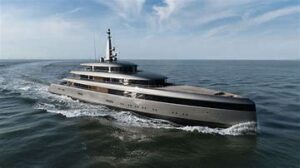
In 2019, Feadship opened the world’s most sustainable superyacht yard in Amsterdam. Last year, it completed Obsidian (photo left), the first of Feadship’s new generation of large yachts. It furthers carbon reduction through hulls optimised at cruising speed, weight control, electric propulsion advances, and the ability to run engines on Hydrotreated Vegetable Oil biodiesel.
Obsidian’s recent launch “stands as a testament to our dedication to reducing the environmental footprint of our yachts, beginning with emissions,” says Verkuyl.
In 2018, Feadship enthusiastically backed the launch of The Water Revolution Foundation, a sector-wide ocean conservation initiative to neutralize the yachting industry’s footprint.
“Yachting relies on the health of the oceans. Their conservation is vital for the planet’s wellbeing,” says WRF’s initiator and sustainability scientist Vienna Eleuteri. WRF’s membership exceeds 50 partners, including yards, designers, naval architects, etc.
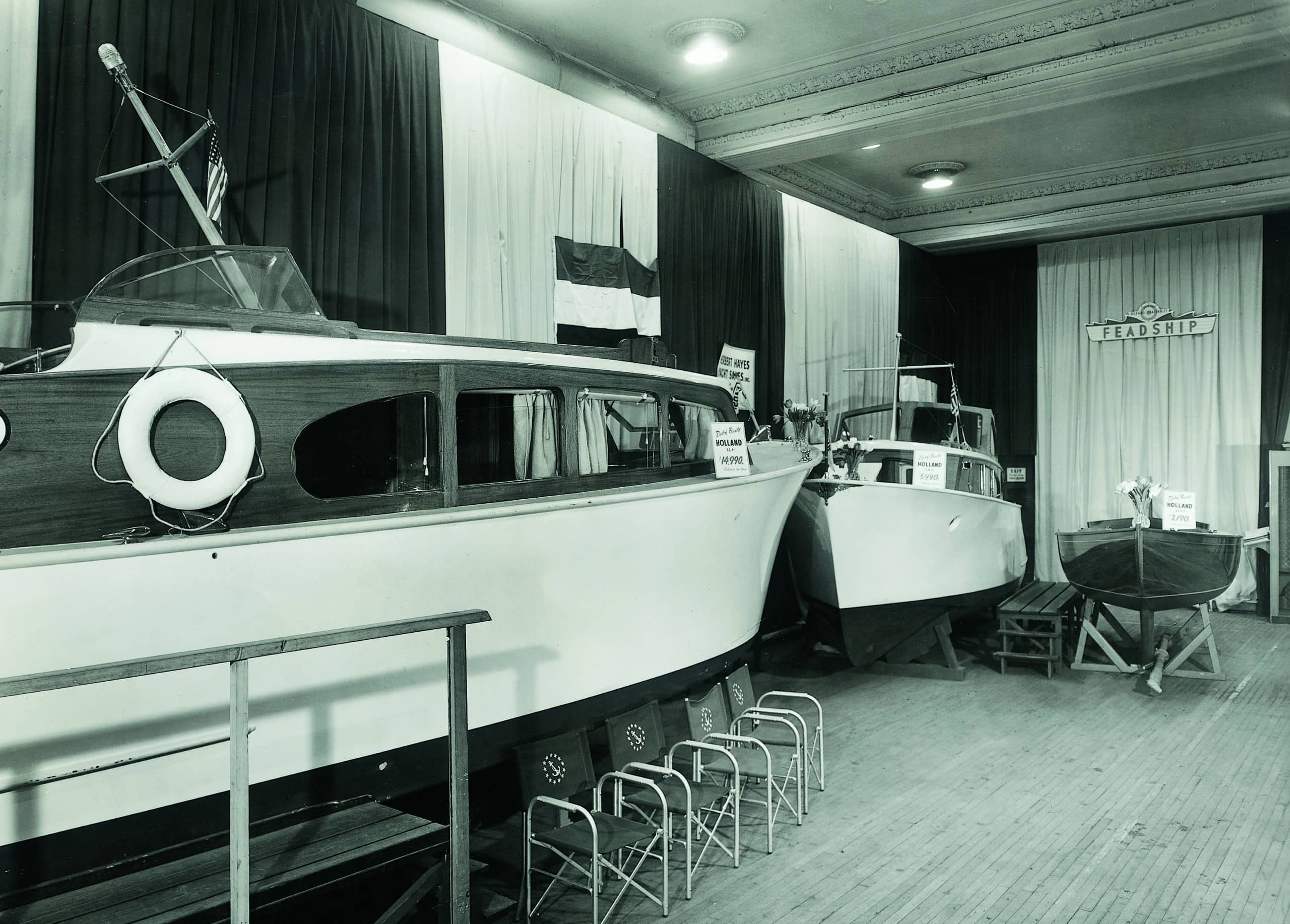
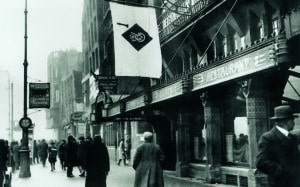 Feadship has seen staggering growth since 1949, when a group of marine business owners met at an Amsterdam café (right) to plot a plan to market Dutch-built boats abroad. The first boats were shown at the New York National Boat Show two years later.
Feadship arose from a pragmatic – some say a desperate – post-World War II plan to rescue Dutch industries by kick-starting exports. With most of Europe still strapped economically and financially, boat builders saw a promising market across the Atlantic.
Assured of some government support, six builders launched the First Export Association of Dutch SHIPbuilders “to promote the export of luxury craft to the United States of America.”
Each member pledged the then princely sum of 500 guilders (about €2.400 today) to fund the marketing venture. Joining the venture soon was naval architect Henri de Voogt, the designer of many future Feadships.
The plan was simple. Each yard would contribute a boat designed for export, and all would share the cost of marketing Feadships abroad. A daysailer and two motor cruisers (one of 8m and one of 10m) were shipped to the 1951 New York Boat Show. All three boats were sold.
The early years came with trouble. With agents, cash flow, the withdrawal of some original members, etc. However, there were also glowing reviews. In the first eight years, 90 yachts were sold in America. Since those early days, Feadship has sold over 500 yachts in the US and, in 2024, will add four more.