Feadship, the Dutch maker of ever larger, highly customized superyachts, unabashedly claims global leadership in carbon-neutral sailing. Its leadership talks about launching the world’s first hydrogen-powered superyacht as an around-the-corner event.


“We have made it our mission to set the tone,” says Feadship Director Jan-Bart Verkuyl. “Not only in word but also in deed.” Fellow director Henk de Vries says half of the buyers on Feadship’s front porch want a yacht with a small ecological footprint. In 2015, he says, it was 10 to 20%.
For Feadship, the 2015 launch of the highly efficient Savannah was a landmark event. Rather than the usual pair of hulking, diesel-guzzling engines, Savannah has a single Wartsila 9L20 four-stroke engine, three generators and a bank of lithium-ion batteries that can deliver a million watts. The complex system allows the boat to run on its diesel engine, on a combination of diesel and electric for extra speed, or on electric power.
That system made Savannah 30% more fuel-efficient than comparable 83m (272ft) yachts. Verkuyl and De Vries are the CEOs of two original yards that formed Feadship in 1949: Van Lent (1849) and De Vries (1906). In the current issue of Pilot, the oh-so-chic Feadship lifestyle magazine, they ooze confidence in Feadship’s goal to switch to hydrogen-powered yachts soon. They also speak of the challenges of developing a “convincing plan” for a zero-emission propulsion system.
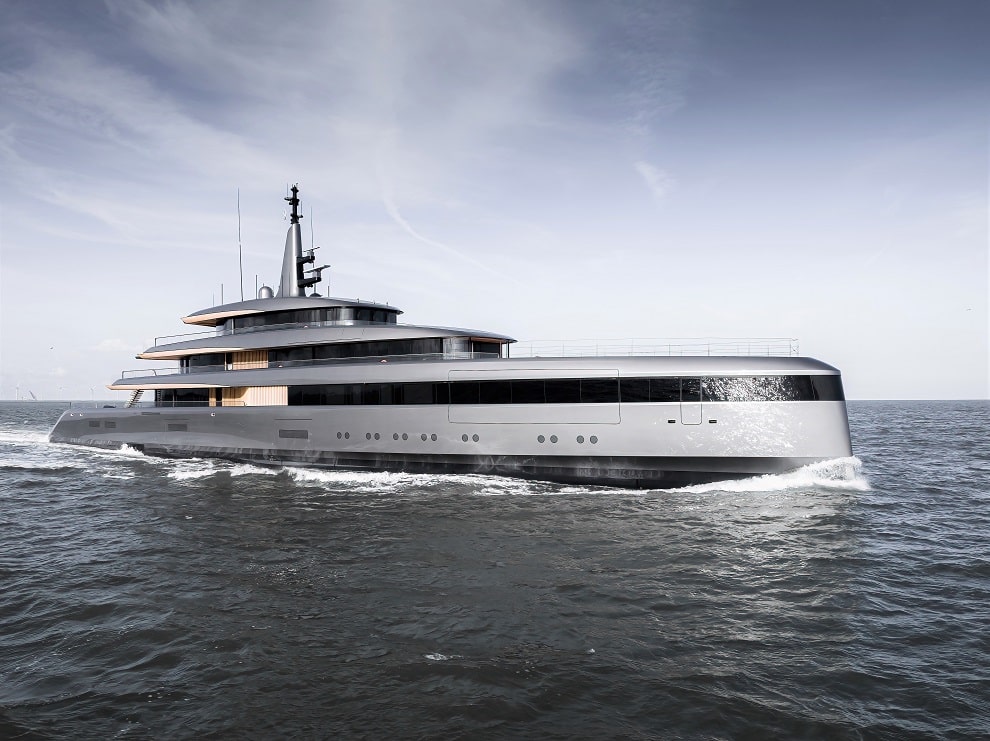
In 2023, Feadship completed Obsidian, the first of Feadship’s new generation of large yachts. It furthers carbon reduction through hulls optimized at cruising speed, weight control, electric propulsion advances, and the ability to run engines on Hydrotreated Vegetable Oil biodiesel.
Obsidian’s recent launch “stands as a testament to our dedication to reducing the environmental footprint of our yachts, beginning with emissions,” says Verkuyl. But stay tuned; A 118.8m (390ft) yacht powered by hydrogen is in build and will be delivered in 2024.
“Project 821 will be the largest Feadship ever built and the first hydrogen-powered superyacht in the world,” says Verkuyl. Diesel/HVO and electric will also power it. “This is an important point to make,” he adds. “As focused as we are on hydrogen, we also know hydrogen will remain complementary to other energy sources such as methanol for the foreseeable future. I truly believe the launch of 821 will be an extraordinary moment for the entire industry and an extraordinary opportunity to discover, hands-on, the opportunities (carbon-neutrality) and limitations (size and safety) of hydrogen.”

De Vries says today’s clients no longer want their yachts optimized around top speed but around cruising speed. Compared to four years ago, the average top speed of new Feadships is down 1.5 knots to 16.5-17 knots.
“Serious discussions now take place around operational and long-range cruising speeds,” he adds. “Top speed isn’t as relevant as most people think, with yachts rarely, if ever, turning to top speed.” He says top speed requires twice the power of running at cruising speed.
In 2019, Feadship formed a ‘Knowledge & Innovation Team’ and gave it “four months to develop a convincing zero-emission propulsion system.” The team quickly ran into the hydrogen storage issue. Working with gas and car industry experts, Feadship designed a 17m (56ft) storage tank with 3,5 tonnes of piping. Fortunately, fuel cell systems quickly improved, enabling Feadship to make significant efficiency gains.
“Increasingly, we see clients willing to invest in technology that will reduce the footprint of our product,” says Verkuyl. “We like to be challenged, and with Project 821, the client did just that.