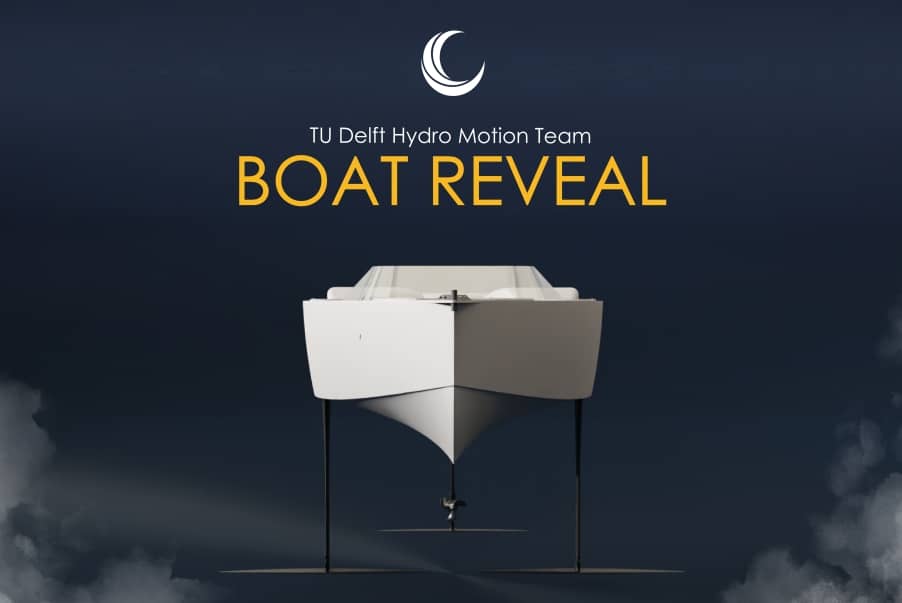
DELFT – Delft University of Technology’s students Hydro Motion Team has unveiled its latest hydrogen-powered boat. This lightweight, mono-hulled craft flies over the water’s surface on foils.

The Aurora is the first “flying” hydrogen craft from a team of 23 students that has focused on solar-powered vessels until now.
The hydrogen boat program is a high-profile undertaking from Delft University, the oldest and largest Dutch public technical university. Its hydro team of students competes in the annual Energy Boat Race off Monaco. The 2023 event will be held July 6 – 8. Organizers expect university and professional teams from 23 nations to participate.
At the May 8 launch of Aurora, Project Manager Helena Westermann talked of hurdles the team had to scale.
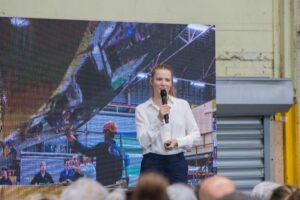
“Before we could start with hydrogen, or even foiling, we had to go back to basics: a working battery-powered boat,” she said. “We went from a hull and loose parts to an electric boat, then to a hydrogen boat and finally … to our goal of a hydrogen boat.”
Aurora was optimized, keeping all components as lightweight as possible. It is a one-piece monohulled carbon fiber boat to keep it maneuverable and straightforward to transport. During construction, the deck was laminated onto the hull. Tubes had to be bent, connected and pressure-tested to install the hydrogen systems.
The hydrogen is stored in a gaseous state at 350 bar in two tanks of 2.3m x 0.5m. The boat carries 10 kg of hydrogen. From the tanks, the hydrogen goes to the fuel cell. The three foils lift the hull from the water when the vessel reaches a speed of 25 km/h.
Like many other Monaco ‘Energy Boat Race’ entrants, the TU Delft students use a prop for propulsion. But the struts and wings beneath the boat are complex, meaning the prop is permanently submerged, even in flight.
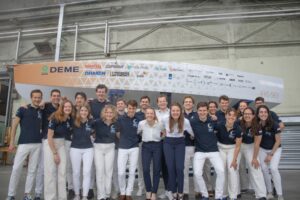 At Monaco this year, “we’ll compete in the Open Sea Class and prove the power of hydrogen,” says Westermann.
“To win, we need to get the highest score over three challenges: maneuverability, speed and endurance.”